Areca Books
120 Armenian Street
10200 Penang, Malaysia
Tel: +60 4 2620123
Fax: +60 4 2633970
Email: arecabooks@gmail.com
Website: www.arecabooks.com

Penang, Through Gilded Doors • More Than Merchants: A History of the German-speaking Community in Penang 1800s-1940s • Penang Trams, Trolleybuses & Railways: Municipal Transport History 1880s-1963 • Our Malaysia: Multi-Cultural Activity Book for Young Malaysians • Kinta Valley: Pioneering Malaysia’s Modern Development • Penang Postcards Collection: 1899-1930s • Streets of George Town, Penang: An Illustrated Guide to Penang’s City Streets & Historic Attractions • Raja Bilah and the Mandailings in Perak: 1875-1911 • Water Watch – A Community Action Guide • Penang Trams, Trolleybuses & Railways: Municipal Transport History 1880s-1963 • Our Malaysia: Multi-Cultural Activity Book for Young Malaysians • Kinta Valley: Pioneering Malaysia’s Modern Development • Penang Postcards Collection: 1899-1930s • Streets of George Town, Penang: An Illustrated Guide to Penang’s City Streets & Historic Attractions • Raja Bilah and the Mandailings in Perak: 1875-1911 • Water Watch – A Community Action Guide

Reviews & Press : : Penang Postcards Collection: 1899-1930s

The Star
13 March 2005
by Peter Zabielskis, Phd Anthropology, New York University

Postcard Journeys, Penang

EVERY once in a while, a book comes along that surpasses expectations. Although there have been other publications about postcards in Malaysia, Penang – Postcard Collection 1899-1930 is by far the most ambitious study of the subject to date. Serious collectors or scholars of postcards (deltiologists, as they are called), as well as casual readers, are sure to delight in this richly illustrated and beautifully designed volume.

Packed with fascinating historical detail, this book is a must-have, not just for anyone with an interest in Penang or the architecture, gardens and public spaces of days gone by, but also for aficionados of ships, trains, trams and other modes of transport, as well as anyone interested in photography, popular culture or postal history.

Authors Khoo Salma Nasution and Malcolm Wade certainly know what they are talking about.

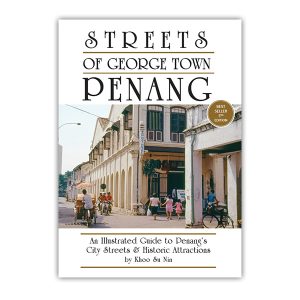
Khoo, a historian and activist for heritage preservation, was the editor of Pulau Pinang, a magazine that combined lavish photography with serious coverage of most aspects of Penang’s vibrant cultural traditions. Her Streets of George Town, Penang has been a perennial best-seller since it was first published in 1993.

Wade is a long-term enthusiast of things Malayan, whose involvement with public service in Malaysia and Singapore goes back 50 years. A former soldier, teacher and author, he is an avid collector of Malayan postal history and postcards.

Together, the two provide a winning combination of cultural knowledge and technical detail about how, where, and why images were captured, printed, purchased and sent off as postcards from Penang during the period of their greatest popularity throughout the world.

By the late 1910s or early 1920s, the Kek Lok Si was already a famous tourist attraction.

The book begins with a survey of what travellers of the time would likely have seen when they arrived by ship at the Port of Penang. It then moves on to the people, places and things to be encountered along the streets of the city, around its coasts and suburbs, up its hills, and back across the strait to Butterworth and Seberang Prai (then Province Wellesley).

Along the way, the history of Penang unfolds as a story that is told visually – through the hundreds of cards in the collection, all of which (even those originally printed in black and white) are reproduced in full colour. The journey is enhanced with informative introductions to each chapter or theme, concise captions that annotate each card, and interesting details that guide the reader with additional points of historical and social interest.
Spectators on an immense tree looking at the various Coronation Boat Races. The inclusion of quotes from first-hand sources – taken from both published commentaries of the time and the messages of people who posted the cards – further contribute to bringing to life the sights and spectacles of old Penang.

Much of the appeal of such visual historical jaunts has to do with imagining what an earlier traveller might have seen and experienced when visiting places that are familiar to us today – and in noting what has changed or what remains the same or similar.

Khoo writes eloquently that, when looking at these glimpses of another time “we behold the streets bustling with pedestrians, hawkers, rickshaws and animal conveyances, with only the occasional tram or motor vehicle in sight; the human-scale architecture, well-mannered walkways and civic spaces; the luscious environs of the Padang, the tree-lined boulevards and suburbs, as well as the rustic scenery of the hills and beaches. We marvel at the city shops, their signs and window displays, as well as the ventures in commerce, plantations and industry.”

These are journeys that may be sentimental but their human content is not completely lost to a by-gone era: they are what we hope for, continue to seek, and can still find in some of the same places in the Penang of today, despite some enormous changes.

Yet what emerges throughout the book is that Penang has always been a place too busy to be nostalgic. Among the most fascinating pages are those that juxtapose images of the same location or scene from different periods of time. Empty lots are quickly taken up by new buildings, small houses are replaced by larger ones. And, in some examples, we see the same tree as a young plant and then again later as majestically full-grown.

For anyone who knows Penang well, the book provides frequent and very pleasurable pangs of recognition – of a favourite old building still standing, the façade of a shop that still operates, and of familiar places that have not yet been completely transformed beyond recognition from what they once were.

Ultimately, the cards did serve an ideological purpose that went well beyond meeting travellers’ needs for souvenirs of the picturesque. They demonstrated to the wider world (most of the cards were sent to Europe) the achievements and modernity of this outpost of empire that, at the same time, embodied certain ideals of beauty as the “Pearl of the Orient”.

Images of new ideas, such as double-decker steam trams, and later, electric trams and buses, are enthusiastically produced and published, and depicted as serving the interests of both industry and leisure, with each system noted in the text as being short-lived and ultimately replaced by something even newer.

Photography at the time was a cumbersome and costly process, and printed postcards became the most popular format for the circulation of photographic images. In the earliest examples, long exposure times meant static poses that limited the possibilities of capturing human subjects in action, so most views include people only as secondary to the grand urban, architectural or natural scenes of which they are a part.

Nevertheless, the cards that do depict people as their primary subjects are among the most fascinating, and these are worthy of further study.

Boatmen in small sampans and stevedores in launches bringing passengers and luggage to shore at Victoria Fair

Even though human action itself is often missing in many of these popular historic images, the products and traces of human effort and enterprise – on both the built and natural environments – always remain the focus.

By the end of the journey, it becomes clear that what both the postcards themselves and this beautifully produced book really document and celebrate is the energy and imagination of the people of Penang.


Dr. Peter Zabielskis recently received a PhD in cultural anthropology from New York University, based on over two years of field research on the built environment of Penang.

© 2006 Areca Books. All Rights Reserved
Designed by Adrian Cheah, Neo Sentuhan Sdn Bhd