There are lots of interesting facts sprinkled within the pages
of the Perak Academys mammoth book Kinta Valley: Pioneering
Malaysias Modern Development which was published in December
last year.
Written
by researchers Khoo Salma Nasution, 42, and Abdur-Razzaq Lubis,
45, the page book chronicles the social history of the area and
its personalities from prehistoric times to Independence Day.
The
book is basically about the transformation of the Kinta Valley
in the wake of the British intervention, and how that has brought
us to where we are today, says Abdur-Razzaq during an interview
in Ipoh recently.
The
428-page volume, which took over a year to write, covers a broad
range of topics from the valleys unique local and immigrant
communities, its roads and railways, to the lean times of the
Japanese Occupation and the Emergency.
While
some may think a coffee-table book on the valley might not make
for very riveting reading, the husband-and-wife team has taken
pains to make its story come alive, be it for student or serious
scholar.
There
is more to Kinta Valley than being the largest tin-producing region
in the world until the mid-1980s and one of Malayas most
important districts.
We
wanted to write about the things not many people know about the
valley, things that tend to be overlooked in the history books.
One
such example is the orang asli whose significance and role in
the development of Kinta Valley appear to have been forgotten,
according to Abdur-Razzaq.
An
entire chapter has been devoted to the indigenous group, which
explains their little known history as one of Kinta Valleys
earliest tin miners. Also included is the part they played in
fighting other peoples wars.
This
aspect is interesting because the orang asli are known to be one
of the most non-violent races in the world. They have always been
very important to Kinta and this has not been explored.
One
account describes how the Senoi orang asli cleverly dealt with
the government and the communist terrorists during the Emergency
in order to survive.
Often
caught between the two sides, Senoi groups either played
dumb and pretended to be stupid, dirty aborigines,
or simply claimed to support one or the other side, depending
on which was nearer.
Also
mentioned, of course, is the famous orang asli army known as the
Senoi Praaq, which has been very successful in tracking
down communist terrorist guerrillas and identifying their camps
during the Emergency.
The
orang asli are not the only community featured in the book, says
Khoo.
As
tin rose in popularity in the 18th century, Kinta Valley increasingly
became a social melting pot for migrating Chinese of the Hakka,
Cantonese, Teochew and Hokkien clans.
They
in turn mingled side by side with a breathtaking mix of Malays,
orang asli, Mandailings, Acehnese, Rawa, Javanese, Tamils, Pathans,
Punjabis, British, Eurasians, French, Dutch, Germans and Americans.
In
the book, we tried to give each ethnic group the attention they
deserve, especially the forgotten communities whose
role Malaysians today might not be aware of.
The
first chapter opens with the authors narrating the historical
significance of the Kinta Valley area as the site of ancient Buddhist
and Hindu civilisations.
The
valley boasts a historical wealth of archaeological artefacts
dating from prehistoric times, and tin miners have been known
to unearth bronze sculptures dating back to the sixth century.
A
capital of the ancient Hindu kingdom of Gangga Nagara dating back
to the early sixth or seventh century was thought to have been
located in Kinta Valley.
Around
the same, sixth to 10th century artefacts unearthed from the valley
also suggests that there had been a Buddhist settlement at one
time, says Khoo.
The
name Kinta Valley itself tends to summon up images
of great tin dredges churning up soil at mining ponds, or of colourful
little towns set in the backdrop of Peraks limestone hills.
Those
same frontier towns Sungai Siput to the north and Kampar
to the south, with places like Papan, Batu Gajah, Gopeng, Kepayang,
Chemor, Kota Bharu, Malim Nawar, Kuala Dipang, Pengkalan Pegoh
and Menglembu in between are all described in the book.
Although
based in Penang, the writers had to do a lot of legwork across
Perak to take photographs and gather material first-hand from
the people who know best the residents themselves.
We
wanted to put a local perspective to the story so that it would
have that connection and become meaningful to them.
Besides
the other research material, we also garnered a wealth of information
from the Perak Government Gazette issues stored in the National
Library in Kuala Lumpur, says Abdur-Razzaq.
Their
fieldwork resulted in 32 pages of colour photographs as well as
over 600 black-and-white photographs and illustrations borrowed
from friends and private archives.
The
exploratory trips also sprang their own surprises on the couple,
like the time when Khoo and Abdur-Razzaq were researching Batu
Gajah, at one time one of Kintas busiest towns. During one
visit to Perak, the couple were dismayed to learn that the Alma
Baker House in Batu Gajah, a landmark thought to be at least 95
years old, had been torn down last September.
Charles
Alma Baker, a surveyor from New Zealand who owned vast tracts
of land and rubber estates during the early 1900s, had built the
house, which was used to film several scenes for the movie Anna
and the King in 1999.
I
was shocked because we had just visited the house to take photographs
of it a week before it was demolished.
It
could have been Batu Gajahs most important asset in drawing
in visitors to this Perak town. To have something like this torn
down, its like nothing is sacred, says a visibly upset
Khoo.
Her
husband points out that one of the interesting stories to come
out of Batu Gajah was the interaction between Baker and a Scottish
planter named William Kellie Smith.
The
two men had started out as associates in early life but ended
up as rivals in business and in lifestyle, from the grandeur
of their homes down to the appearance of their horses and carriages.
Until
recently, Batu Gajah had the Alma Baker house and Kellies
Castle built by William Kellie Smith.
Although
the state government has done a lot to promote the castle, the
story of these men is impoverished by the destruction of the Alma
Baker house, he says.
The
couple say that if handled correctly, Batu Gajah could have been
modelled after Taiping as a Bandar Warisan (heritage town) in
its own right.
Mine it for education
and tourism
By
Christina Koh
A
book on Kinta Valley would not be complete without mentioning
the tin-mining activities that put the area on the world map.
Everything
is covered here, from the mountain mines called lampang
preferred by Malays, and the cangkul (hoe) and wicker baskets
used by the early Chinese miners, to the mighty dredges brought
in by the Europeans.
Tin
is not Kinta Valleys only legacy, however, according to
Prof Wang Gungwu of the East Asian Institute in Singapore.
The
valley, wrote the professor in the books preface, was also
the site of sweeping achievements in politics and education, besides
the bustling commerce at numerous frontier mining towns.
It
was in Kinta that men like nationalist Datuk Ahmad Boestaman and
Aminuddin Baki, Malaysias most important educationist, had
been active, as well as key leaders of Umno, MCA and the Malayan
Communist Party.
Casual
readers flicking through the pages of the book may find themselves
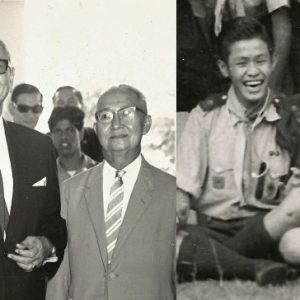
tickled by some of the candid black-and-white photographs of yesteryear.
Among
the collection are rare shots of Ipoh in its early days, photographs
of the Hong Kong child star Fong Po Po advertising Menglembu groundnuts,
and of Kinta nobles going on a picnic on the backs of 56 elephants.
The
couple are no stranger to the tricky research and legwork needed
to write a book on a subject as encompassing as the Kinta Valley.
In
1999, they penned the popular heritage map Ipoh: The City that
Tin Built, which provides reader-friendly snippets of heritage
sites around the town.
They
later joined forces to write Raja Bilah and the Mandailings
in Perak: 1875-1911, a 278-page book about Abdur-Razzaqs
ancestors which was published by the Malaysian Branch of the Royal
Asiatic Society in December 2003.
With
their latest book finally out of the way, Abdur-Razzaq reflects
that Kinta Valley has three main attractions
the orang asli, its tin mining history and the splendour of its
limestone hills.
As
long as there has been Man, there has always been a human relationship
with the limestone hills, says the self-proclaimed social
activist.
Even
now, it becomes all the more urgent to preserve Peraks limestone
hills before they disappear. The past is so rich that people should
cherish and appreciate that.
Like
the limestone hills, like the traditions of the orang asli, these
should be kept for the future.
Of
course, I realise that it is not possible to save everything and
Im not suggesting that all development should freeze.
I
just think that cultural and heritage sites should be treated
as education and tourism assets. They are our investment for present
and future generations.
The
story of Kinta, once the wealthiest district in British Malaya,
is essentially the bittersweet tale of the countrys birth
into the modern era, says the author.
This
is a book in which we try to say that Malaysians should understand
their history. Without a past, there is no future.
The
authors are currently working on the Perak Postcard Collection
with postal historian Malcolm Wade, and hope to produce the postcards
by the end of the year.
Kinta
Valley: Pioneering Malaysias Modern Development by Khoo
Salma Nasution and Abdur-Razzaq Lubis; preface by Wang Gungwu;
published by Perak Academy, a non-profit organisation that aims
to nurture the state into a centre of excellence in thought, culture
and technology; 3,000 copies; 29cm x 26cm, 428 pages; 607 illustrations
410 b/w, 197 colour; RM149.90. Direct orders/enquiries
to Mr Yeap (04-2620123, fax: 04-2633970, or e-mail: januspenang@myjaring.net).