Areca Books
120 Armenian Street
10200 Penang, Malaysia
Tel: +60 4 2620123
Fax: +60 4 2633970
Email: arecabooks@gmail.com
Website: www.arecabooks.com

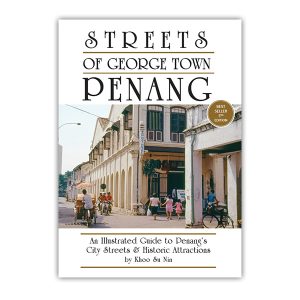
Heritage Houses of Penang • English-Penang Hokkien Pocket Dictionary • The Chinese in Penang: A Pictorial Essay • Days Gone Bye: Growing Up in Penang • Road to Dawn: Fliming in Penang • Tulila: Muzik Bujukan MandalingPenang, Through Gilded Doors • More Than Merchants: A History of the German-speaking Community in Penang 1800s-1940s • Penang Trams, Trolleybuses & Railways: Municipal Transport History 1880s-1963 • Our Malaysia: Multi-Cultural Activity Book for Young Malaysians • Kinta Valley: Pioneering Malaysia’s Modern Development • Penang Postcards Collection: 1899-1930s • Streets of George Town, Penang: An Illustrated Guide to Penang’s City Streets & Historic Attractions • Raja Bilah and the Mandailings in Perak: 1875-1911 • Water Watch – A Community Action Guide • Penang Trams, Trolleybuses & Railways: Municipal Transport History 1880s-1963 • Our Malaysia: Multi-Cultural Activity Book for Young Malaysians • Kinta Valley: Pioneering Malaysia’s Modern Development • Penang Postcards Collection: 1899-1930s • Streets of George Town, Penang: An Illustrated Guide to Penang’s City Streets & Historic Attractions • Raja Bilah and the Mandailings in Perak: 1875-1911 • Water Watch – A Community Action Guide

Reviews & Press : : Fatimah's Kampung

KEMANUSIAAN 16 (2009), 115–120

FATIMAH’S KAMPUNG
The author of Fatimah’s Kampung, Iain Buchanan, is an independent writer/illustrator.
Below is an account of the author’s creative process.

Author's Creative Process
Discovering Fatimah’s Kampung
by
Iain Buchanan
mazhb44@yahoo.co.uk

For about 25 years, I taught geography to university students. My particular interest was in economic and political geography, and Southeast Asia. But I was also very interested in how we represent, graphically, complex economic and ecological systems, the flows of their constituents, and their statistical measurements. For much of my working life, I struggled with the problem of best to communicate the best, as a geographer, complex interrelationships in a way which was both graphically clear and academically acceptable.

But underlying my efforts, there was a growing dissatisfaction. Some of this dissatisfaction stemmed from the "theological" warfare that has long raged within Geography about just how the subject should be defined. The subject I was teaching about, very broadly, was the human environment, or the landscapes we live in. And for me at least, it was a subject that had to be approached in a holistic, and multi-disciplinary, way. This seemed self-evident. For how else could one even begin to understand the interaction between a complex humankind within an equally complex global ecosystem? The more I taught, and the more I learned, the more I realised how infinitely interrelated our world is, how complex its problems are, and how complex, too, are the solutions we need to devise.

But as well as this realisation, there was also an awareness that the world around me was growing sicker and sicker by the day. My teaching was very much concerned with problems – problems of economic development, political conflict, social disparity, cultural breakdown, and environmental degradation. And most of these problems, it seemed, were getting worse. Statistically, improvements could be claimed in such things as income per capita or aggregate food supply or levels of literacy. But statistics, all too often, are like well-behaved children – they do just as they are told. Indeed, when it came to more holistic, more qualitative, measures of change – of changes in structures, in systems, of life – there was deep cause for concern. For this world of ours, this world we so loved to call our "global village", seemed to be on the brink of collapse. This much, even 30 years ago, was palpably obvious. As an ecological system, and as an economic system, our world was falling apart. Its very complexity was getting the better of us.

So there I was, droning on about a world that was coming to pieces around me, to an audience of students who really didn't care very much and with academic colleagues who berated me for not being scientific enough, for not being finely-focused enough in my analysis, and for scare-mongering. One colleague, a climatologist, dismissed the challenge of climate change (particularly global warming) by snorting: "Global warming? What rubbish! We won't know if there's a problem here for at least another 100 years – by then, maybe, we'll have a proper run of statistics." Another, an agricultural geographer, dismissed the question of rural poverty in Asia with the observation: "If peasants are poor they've only got themselves to blame for not modernising and adopting the market." As for the students: well, knowledge of the outside world was not quite as important as the cost of beer in the university bar; and for most a career in commerce, but more preferably finance, was the keenest ambition.

More and more, it seemed to me, university teaching (especially in Britain) was not what I wanted to do. There seemed to be both a problem of perception (how problems were seen and analysed), and a problem of communication (how the message was transmitted from the university to the rest of the world). Let me say a few words about each of these problems. Firstly, it seemed to me that we were defining the world in the wrong way: In particular, we were failing to treat the world we lived in, our environment, our landscape, with sufficient respect; and, also, we were failing to see it holistically enough. For us academics, as much as for the politicians and businessmen of the world, intellectual and commercial "rationality" reigned supreme. We had our fine and sympathetic phrases: We talked about equity, sustainability, grassroots development. The difficulty was, all too often, we were trying to solve. To put it simply, our definition of the environment we lived in was too utilitarian, too technocratic, too compartmentalised. Sadly, we had been seduced by our own cleverness, and we were losing our humility. We were losing, too, our sense of wonder at God's creation, our vital spiritual connection with the earth we sprang from.

To many a Western-trained ear, of course, that sounds sentimental, romantic. And this was precisely the problem: of those in charge of our environment, too many would say "We do not need a spiritual connection with the landscape – we have the power, after all, to shape it completely to our needs, and the rationality to do so wisely." So this was our first problem.

Secondly, how were we, as teachers, communicating our ideas about the world we lived in? Well, in Britain during the 80s and 90s, we had plenty of political correctness. We had concern for things like human rights (in particular the rights of the child and of sexual minorities), for conservation, for recycling, and for multiculturalism. Unfortunately, much of this concern was little more than issue politics and managerial sloganeering. And under the cloak of such political correctness, the education system was hardly growing any more enlightened. The universities, like the schools, were obsessed with quantitative targets and private sector tie-ups. We were also, it must be said, obsessed with the business of foreign fee-paying students. Everything had a price, everything had a commercial pay-back calculation … and everything was possible. The trouble was, the real world didn't work like that. Certainly, the natural environment didn't work to such logic. And so, when it came to teaching such things as environmental studies, or environmental conservation, there was always a disjunction (within our own academic disciplines) between the need for teaching to be utilitarian, and the need for teaching to be critical and creative and forward-looking. To me, this seemed to suggest the university learning – at least as far as I had experienced it – didn't offer much hope for our ailing world.

But it was not questions like these that finally propelled me into a change of career. In the midst of all this questioning, and quite without warning, I met one of my ex-students from the days I'd spent teaching in Singapore and Malaysia, back in the 1960s. Maznoor had been a somewhat sceptical listener in those days – and rightly so, given how little expats like me really knew of the world they were talking about. But by now, perhaps, I had matured somewhat, and I was a little less cocksure. Anyway, Maznoor did her post-graduate studies and soon afterwards we married. As a result, I rediscovered Malaysia, and became part of Maznoor's wider family. I gained some nieces and nephews – and in time a small crowd of cucu (grandchildren) as well.

And it was these developments which really sealed my fate. With Maznoor's encouragement, I left university. As I grew into my new family, I rediscovered a connection with the world which – as an academic – I had almost lost. The connection, if you like, of the spirit. My visits to Malaysia become more frequent and longer. And each one was a voyage of discovery. But the landscapes I was discovering now were not strange and unusual landscapes; on the contrary, they were very ordinary ones. Maznoor and I would go to the kubur (cemetery) where her father and brother were buried to say our prayers; we would help out in my brother-in-law's garden in Batu Pahat, or we would climb nearby Gunung Soga (Soga Mountain) to walk through the jungle; we talked to the people who belonged in these landscapes, who called them "home". And slowly, the inspiration for Fatimah's Kampung took root.

It was the children who inspired me the most – my nieces and nephews, and their children, and their children's playmates. These kids were the ones who would inherit the world we older people left behind. But the world we were leaving them was in a mess, and they had to make a better job of looking after it than what we did. My instinct as a teacher was that I had to get across to them some kind of warning, and some kind of hope too, about the way the world was going – a message about where we have gone wrong, and about the need to protect and revive the earth God gave us. But how to communicate? Certainly not by lecturing. And, for that matter, not even in words if I could help it. The ideas were there (I had drawers full of lectures, after all) but the message, and the medium, had to be one which would catch the attention of children, and engage them because they wished to be engaged – not because they had an exam to sit at the end of term.
I was not about to change my ideas. But I did have to repackage them. Eventually, I decided I would try to communicate, through pictures, a story with two simple themes: Firstly, how beautiful, how richly-detailed, our world really is; and secondly, how bleak and miserable we can let it become. The problem was: I didn't know how to draw pictures, beyond the odd cartoon I'd done for the family. And I truly shuddered at the thought of the sort of things I would have to draw pictures of. Just to take one example: For me, and for a lot of other people too, no doubt, one of the most glorious of God's creations is an ancient forest, crowded with life, tangled and climbing and majestic. If I was going to celebrate such wonder, I had to draw it properly. It was the same with the keramat, and with Fatimah's family home. Here was a landscape, the landscape Fatimah belonged to, that had to be celebrated. And so the landscape, and all the wonderful things within it, had to be drawn properly. At the same time, the fate of Fatimah's landscape – the fate of the forest, the hill, the kampung, the keramat, the tiger … this too had to be convincing. In the end, I had to be able to say that I had done a sort of justice to the wonders of nature, to the complex beauty of the natural environment, as well as to the vitality and the artistry in the lives of ordinary people. But the academic in me also had to be able to say that I had covered all the main topics in my lecture notes: That I had covered, for example, Biodiversity in the Tropical Rainforest; Sustainable Use of Forest Products; Deforestation and Erosion; Over-urbanisation; the Commodification of Cultural Heritage – and I had done so without turning people off with phrases which sent them to sleep.

And so I re-skilled myself. Through a long process of trial and error, I learned to draw. I drew on a large scale, so that I could capture the detail of things, and then I reduced my pictures – by between four and twenty times – and coloured them. It was a matter of principle, to me, that if I was to do justice to my subject – to Fatimah and her kampong, to the skill of craftsmen and the beauties of Nature – then I could not use a computer, even on the most repetitive, the most mechanical, of tasks. So my only concession to electronics (I think) was the photocopier. It wasn't only the artwork I had to work on, of course. I also had to try to write without jargon – which for academics is not always easy.
It was a long process. The book took eight years to do. And if I needed patience, so did Maznoor. From the start, Fatimah's Kampung was very much a partnership. It was Maznoor who had the foresight to encourage me to go beyond mere grumbling and retire from University. It was Maznoor's reminiscences, and Maznoor's enthusiasm, that gave me my early inspiration. And when our income fell short, it was Maznoor who insisted on going out to work.

In the end, hopefully, the book which emerged from our joint efforts will, in some small way, do what we both wished it to do. It will celebrate our Malaysian family, and it will celebrate too some of the things which we both love about Malaysia. But that is not all. I hope too it will have a wider relevance. I would like to feel that people (and not just children) will linger over its pages and reflect a little on what is happening to the landscapes we spring from, the landscapes we depend upon and call our home.
And goodness knows, we certainly need to reflect. We are at a truly critical point in the life of this earth. There is absolutely no question that our global environment is in crisis – and it is entirely our fault. Not least, we have upset the world's climate to a quite disastrous degree. Global warming is accelerating, with severe effects throughout the global eco-system. The polar ice caps are retreating, glaciers are melting; sea levels are rising and seas are dying through acidification. Some island nations, effectively, will disappear off the face of the earth. The world's forests – especially the critical old growth mixed forests – are shrinking, and soil erosion has long been causing soil fertility to decline over vast areas of the planet. And as a concomitant of this ecological devastation, the economic divide between the dominant rich and the dispossessed poor is in many ways much wider. We must never forget that the ecological footprint of the rich, harsh enough on the world as a whole, is especially harsh on the landscapes of the poor. We could go on. What matters, what is literally a question of life or death, is that our greed and our arrogance have brought havoc to the earth's eco-system. And now, it is clear, that same greed and that same arrogance have brought havoc to the global economic system as well. These are, after all, merely two sides of the same problem. The global structure of our livelihood has, effectively, collapsed.

We can, of course (and we will), indulge in plenty of crisis management. We are good at that. We will control the use of plastic bags. We will plant trees in towns. We will bring forward work on electric cars and solar power. We might even tax petrol a bit more. And we will pump more money into the banking system. But none of this will really work. And it won't work because the vital infrastructure for a truly sustainable world just isn't in place – our agricultural and fishery systems are criminally wasteful, our public transport systems are laughable, our personal consumption patterns are profligate and destructive, and our financial systems are short-sighted jokes. So the seas will go on rising, the hills will go on crumbling, and the haze will only get worse.

The issue is a very simple one. If we educated human beings are the guardians of God's creation – as we so often claim we are – have we really been doing our duty? Especially to future generations, to our children and our children's children? Or is our attitude to the earth a bit like the attitude of the stock market speculator – to hell with the long term, let's make the most of the short term? Perhaps there is something of this attitude in all of us. And, all too often, we dress it up with rationalisations about population growth and the need to keep expanding the economy. But in doing so we miss the point. Do we really think the poor have only themselves to blame? And do we really think that God's creation is infinitely expandable, subject only to our technological brilliance?

In every crisis, perhaps, there is an opportunity. Hopefully, the economic collapse will show us, in the most tangible way possible, how truly and disastrously stupid we have been. Now, we must proceed with far fewer expectations, with far less profligacy, with far more humility. At the very least, let us hope, this will force us to tread more lightly on our environment.

But I will conclude on a personal note. The launch of my book, Fatimah's Kampung, has brought together two quite different institutions – a university, Universiti Sains Malaysia, and a campaigning NGO, the Consumers' Association of Penang (CAP). For one with such jaundiced memories of academic life, it is heart-warming to see these disparate (but very interrelated) institutions joining forces on two of the most critical issues now facing us – those of conserving the environment and pursuing sustainable, and equitable, development.

My hope is that this coming together will be a catalyst for much more cooperation, and that brave and serious minds in both groups will join with others, and do something to rescue us from the worst of the crisis we face now. Most particularly, perhaps, in framing that most elusive of all requirements – a truly holistic understanding of what is very much a holistic problem. But beyond this, perhaps Universiti Sains Malaysia and CAP can take two equally essential further steps: first, by framing holistic and integrated solutions; and second, in doing so, by having the courage, and the wisdom, to actually retreat for once – away from economic growth, away from speculative "development", away from technological adventurism – so the damage can begin to be repaired.

Fatimah's Kampung, more than anything else, is a symbol of our predicament. Some will say it is idealistic. Well, we use ideals to sell fast cars, fast food, cosmetics, jewellery, designer clothing, self-motivation courses, and exotic holidays. Perhaps a little idealism, in the service of children like Fatimah, is no bad thing.

IAIN BUCHANAN

© 2007 Areca Books. All Rights Reserved
Designed by Adrian Cheah, Neo Sentuhan Sdn Bhd