Areca Books
120 Armenian Street
10200 Penang, Malaysia
Tel: +60 4 2620123
Fax: +60 4 2633970
Email: arecabooks@gmail.com
Website: www.arecabooks.com

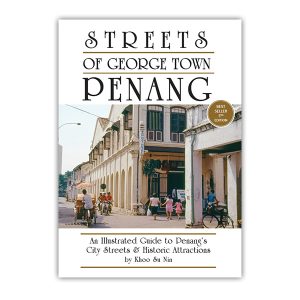
Heritage Houses of Penang • English-Penang Hokkien Pocket Dictionary • The Chinese in Penang: A Pictorial Essay • Days Gone Bye: Growing Up in Penang • Road to Dawn: Fliming in Penang • Tulila: Muzik Bujukan MandalingPenang, Through Gilded Doors • More Than Merchants: A History of the German-speaking Community in Penang 1800s-1940s • Penang Trams, Trolleybuses & Railways: Municipal Transport History 1880s-1963 • Our Malaysia: Multi-Cultural Activity Book for Young Malaysians • Kinta Valley: Pioneering Malaysia’s Modern Development • Penang Postcards Collection: 1899-1930s • Streets of George Town, Penang: An Illustrated Guide to Penang’s City Streets & Historic Attractions • Raja Bilah and the Mandailings in Perak: 1875-1911 • Water Watch – A Community Action Guide • Penang Trams, Trolleybuses & Railways: Municipal Transport History 1880s-1963 • Our Malaysia: Multi-Cultural Activity Book for Young Malaysians • Kinta Valley: Pioneering Malaysia’s Modern Development • Penang Postcards Collection: 1899-1930s • Streets of George Town, Penang: An Illustrated Guide to Penang’s City Streets & Historic Attractions • Raja Bilah and the Mandailings in Perak: 1875-1911 • Water Watch – A Community Action Guide

Speech by Ilsa Sharp,
on 'Hail, Penang!' by George Bilainkin

at book launch
10 July 2010, Penang

Lovely to see so many old friends and new friends gathered here today.

In fact, I have made a completely new set of friends just because of this book launch!

Via email, I have discovered the brothers Saravanamuttu, Johan and Manicam. And Manicam actually lives practically alongside me, in Perth, Western Australia - yet amazingly, in such a small town, we had never met before!

Their father's book 'The Sara Saga' is an even more rare find these days than Bilainkin's 'Hail Penang'. So Khoo Salma and Lubis of Areca Books have done Penang and all of us a huge favour with this twin reprint of both books. I was honoured to be asked to write the Foreword for Bilainkin's book. Thank you, Salma and Lubis.

Thank you especially for your tolerance when I produced a four thousand word Foreword, a length that would sorely stretch most publishers' patience!

I don't intend to regurgitate what I've already written about George Bilainkin himself in my Foreword. So please buy the book if you really want to know the detail of what I have said!

There is still much more to be discovered about Bilainkin, who later became a fascinating commentator on World War II Europe and post-War Asia. He was a gifted journalist and displayed unusual empathy with colonised Asia.

He was often a prescient analyst, not only predicting the War itself quite early on in the 1930s, but also understanding early how the post-War scene would evolve across Asia into unstoppable independence movements.

His book Destination Tokyo was published in 1965. Typical of Bilainkin's personal hubris, it was sub-titled A Famous Diplomatic Correspondent's Urgent Warning to the West about Tomorrow in Asia. And indeed it was just that, an urgent warning.

In this book, Bilainkin prophesied in apocalyptic tones of Asia's imminent settling of past scores with white, western civilisation. He urged the West to respond to Asia's needs of that moment with greater generosity, with technical, financial and social aid - or else. He made a passionate plea for the West to abandon its mindless search for material wealth and its obsession with trivia such as the Beatles and television, and open its eyes to Asia's rising power.

He was overwrought and hysterical, perhaps. The East-West relationship has turned out to be more measured than he foresaw. But we must remember that he wrote in the shadow of the nuclear bomb and the shock of an earlier Western defeat by an Asian power.

I'll just sketch out some thoughts on the socio-political context within which Bilainkin lived and worked in Penang during the early 1930s. This was of course, British colonialism in pre-World War II Malaya. Bilainkin was a humane but still essentially colonial observer of those times.

Needless to say, colonial history researchers like myself encounter heaps of prejudice, stereotypes and misconceptions - and all manner of other violent emotions - attached to the very word 'colonialism'.

I like to 'poke fire' now and again by cautioning that colonial society was not all as 'black and white', nor as uniformly cruel and oppressive as some would have it today. We risk misunderstanding when we view that hopefully long-lost society through the distorting prism of 21st -century spectacles.

For example, when we look at the apparently apartheid principles underpinning the segregation of pre-War Malayan social and sporting clubs, it's easy to forget that this was a social norm of the time as natural as eating and breathing, accepted by all parties involved. That does not make it an acceptable system, just an easier one to understand.

It would have been almost as uncomfortable for a Ceylonese or Eurasian to see orang puteh coming into his club, as it would have been unthinkable for the reverse to occur. So long as this version of 'pax Britannica' persisted with the consensus of its participants, it was a perfectly harmonious form of social order for those who lived with it at that time. Nobody on either side was particularly bothered by it; it was just 'the way things were.' But of course, once expectations changed, so did the whole ball-game.

There were also many pre-War colonials who used their own individual initiative to break through what George Bilainkin himself reviled as 'the colour bar', and to make little gestures of humanity, reaching across the barriers.

Many colonial officers were also well versed in local cultures and languages. Partly because of the difficulties of international travel in those days, but partly also because they loved Malaya, they just never went 'home.' They would compare very favourably with your typical three-year contract expat today, who is able still to tap into international goodies, communications and social milieus even while operating in Malaysia or Singapore, and who is able to jet home at the drop of a hat - but who is also completely isolated from, and ignorant of local cultures and languages.

You often hear it said that the seeds of the 1950s independence movements in this region were sown when the locals saw their British masters either walk off and abandon them in the face of the Japanese invasion, as at the fall of Penang and Singapore - or else when they saw them generally defeated and humiliated by an Asian power during World War II. Bilainkin himself espoused this view in many of his writings.

While there is some truth in this, and the War certainly accelerated the process, in fact, the genesis of Independence lay much further back in the 1930s. An evolutionary process was already underway. The local people's relationship with the colonial rulers had already shifted gear before the War: many Malayans, the Babas of Penang among them, had returned from foreign English-language educations, armed with a new confidence and higher expectations - and overseas, they had seen how much more diverse European society was in the motherland, including both lower and upper classes.

And on the other hand, among the expatriates themselves, a new generation held different, more egalitarian, views from their seniors in colonial society - and at home, a wave of European socialist philosophy was lapping at the shores of Britain.

So the pre-War 1930s were a transitional phase in the journey towards Independence. I see George Bilainkin as representative of this transition.

You can see the tug of both eras in his writings - Pax Britannica and Merdeka. He was a passionate critic of British snobbery and the so-called colour bar, both of which he observed closely as they operated in the social life around the Eastern & Oriental Hotel or 'E&O' where he was himself resident; yet he was also a compassionate chronicler of the desperate loneliness of the long-distance planter and his wife, stuck out on the ulu estates of Malaya with nothing to do.

Bilainkin was what we in today's psycho-babble would call 'a very conflicted personality'. But in that he only epitomised a very conflicted era in Malayan history.

We are still living with some of the aftermath of that conflicted psychology. That's why Bilainkin's 'Hail Penang!' is still a very good and very relevant read today. Do read it...

See: The British in Malaya 1880-1941, John G. Butcher, OUP KL 1979.

© 2007 Areca Books. All Rights Reserved
Designed by Adrian Cheah, Neo Sentuhan Sdn Bhd